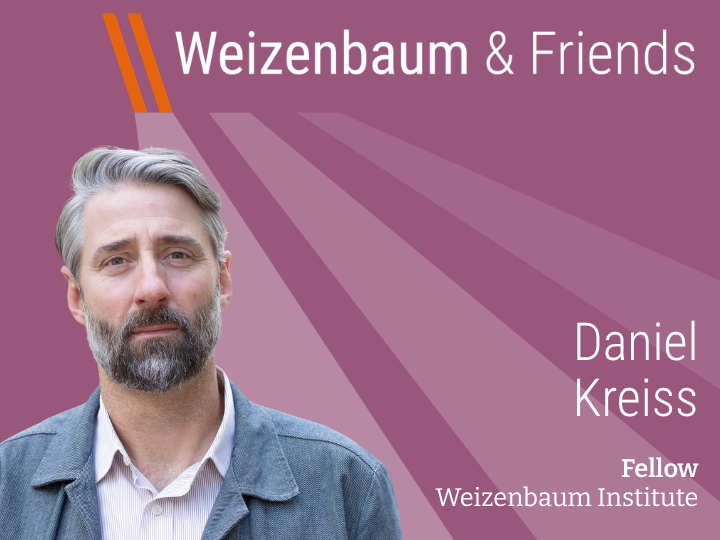
Fellow Daniel Kreiss: On Media Research and Academic Collaboration
13.04.2026Daniel Kreiss, a leading expert in political communication and Professor at the University of North Carolina at Chapel Hill, joined the Weizenbaum Institute as a Fellow in 2019. In our series “Weizenbaum and Friends”, he reflects how his research on platforms, power, and democracy connects with the institute’s collaborative environment—and how meaningful encounters during his stay led to lasting academic partnerships.
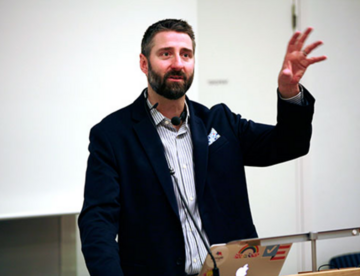
Daniel Kreiss is the Edgar Thomas Cato Distinguished Professor at the Hussman School of Journalism and Media, and Professor at the School of Information and Library Science at the University of North Carolina at Chapel Hill. He also serves as Faculty Director, Principal Researcher, and co-founder of the UNC Center for Information, Technology, and Public Life, which is an internationally recognized hub for research on disinformation. With an extensive publication record, including five authored or co-authored books, Daniel Kreiss is a leading voice in the field of political communication in the digital age. In 2019, he was a fellow at the Weizenbaum Institute, and talked to us about his stay.
Daniel Kreiss research centers on a pressing question: How can media and technological systems be shaped to serve democratic and public life? His work examines how journalists can work to alert the public to democratic threats, platforms can promote democracy through design and policy, and civil society institutions can exercise communicative forms of accountability over those in power. Through this multifaceted approach, Kreiss contributes to a deeper understanding of the relationship between technology, power, and democracy.
His connection to the Weizenbaum Institute reflects the importance of collaborative and interdisciplinary environments for advancing research. When asked about his time at the institute, he emphasizes the people there as the defining feature. Alongside formal research exchanges, it was the informal conversations—whether during discussions or over coffee—that made his experience particularly meaningful and intellectually stimulating. These interactions also laid the foundation for lasting collaborations. During his fellowship, Kreiss met Ulrike Klinger, with whom he has since worked on multiple projects, including the widely adopted textbook Platforms, Power, and Politics: An Introduction to Political Communication in the Digital Age (2023). He also connected with Curd Knüpfer, which led to the organization of a workshop on far-right dynamics at the Weizenbaum Institute and a paper in the journal Political Communication. These collaborations show that institute is a space where scholarly exchange translates into long-term academic partnerships.
Daniel Kreiss chose the Weizenbaum Institute for his fellowship because of its unique combination of intellectual community and location. Situated in the heart of Berlin and embedded within a broader ecosystem of academic, political, and civil society institutions, the institute offers an ideal setting for interdisciplinary dialogue and impactful research. For him, it is precisely this environment—shaped by engaged scholars and vibrant exchange—that continues to make the Weizenbaum Institute a place of enduring collaboration.
About the Fellowship
The Weizenbaum Institute Fellowship enables national and international researchers at all career stages to carry out joint research projects and establish long-term collaborations. The goal is to bring new perspectives to the Institute’s research and to strengthen academic networking further. Since the institute’s founding in 2017, over 357 fellows from 47 countries have been affiliated—an international diversity that our format „Weizenbaum & Friends“ showcases regularly.