
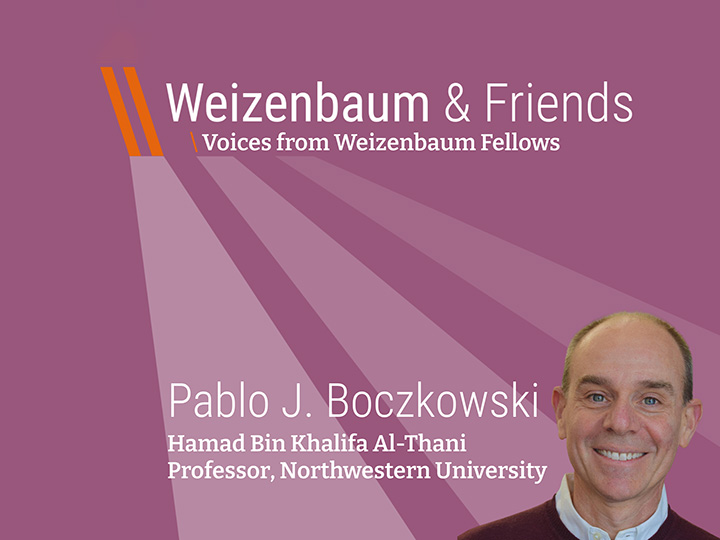
Pablo J. Boczkowski: Comparative Perspectives on Digital Cultures and Interdisciplinary Exchange
29.06.2026Pablo J. Boczkowski is Hamad Bin Khalifa Al-Thani Professor in the Department of Communication Studies at Northwestern University.
Pablo J. Boczkowski holds doctorates in Clinical Psychology and in Science and Technology Studies, and his research program examines digital cultures from comparative perspectives across domains such as news, journalism, politics, everyday life, and mental health. His scholarly contributions include eight monographs, among them Digitizing the News: Innovation in Online Newspapers, which uniquely received both the Outstanding Book Award (2005) and the Fellows Book Award (2023) from the International Communication Association. He has also published five edited volumes and more than sixty journal articles. His academic career includes fellowships and leadership roles at the International Communication Association and the Institute for Advanced Study in Princeton. In 2025, he was awarded the Argentine “Premio RAICES” in Social Sciences and Humanities for his contribution to strengthening international scientific collaboration. Furthermore, Pablo Boczkowski is a member of the Editorial Board of the Weizenbaum Journal of the Digital Society (WJDS).
Reflecting on his time at the Weizenbaum Institute, Boczkowski emphasizes both intellectual and social dimensions. “Intellectually, an outstanding interdisciplinary environment, and socially, a most welcoming community in one of my favorite cities in the world,” he notes.
He describes his work as examining “digital cultures from comparative perspectives,” with a long-standing interest in how digital transformation reshapes institutions such as journalism and, more recently, mental health systems. His current book project, Digital Freud, explores “how the digitization of the mental health professions reveals fundamental transformations at the nexus of technology, selfhood and society in contemporary society.”
During his time at the Weizenbaum Institute, Boczkowski particularly valued the collaborative academic environment and the openness across disciplinary boundaries. He highlights “the collegiality and low barriers of communication across disciplines, as well as the unwavering commitment to excellence” as key features of his experience. These conditions, he suggests, enable productive exchanges that move beyond traditional academic silos and foster new perspectives on digital transformation.
He chose the Weizenbaum Institute for its interdisciplinary orientation and broad conceptual approach to digital society. The Institute, he notes, “cast a wide net on an array of phenomena I was interested in, its interdisciplinary approach, and its unique location in one of the world’s most vibrant (and fun!) cities.” For Boczkowski, this combination of intellectual breadth and urban context provides an especially fertile environment for comparative and collaborative research.
Overall, his fellowship reflects a sustained engagement with the evolving nature of digital cultures and underscores the importance of interdisciplinary collaboration in understanding how technological change reshapes contemporary social life.