
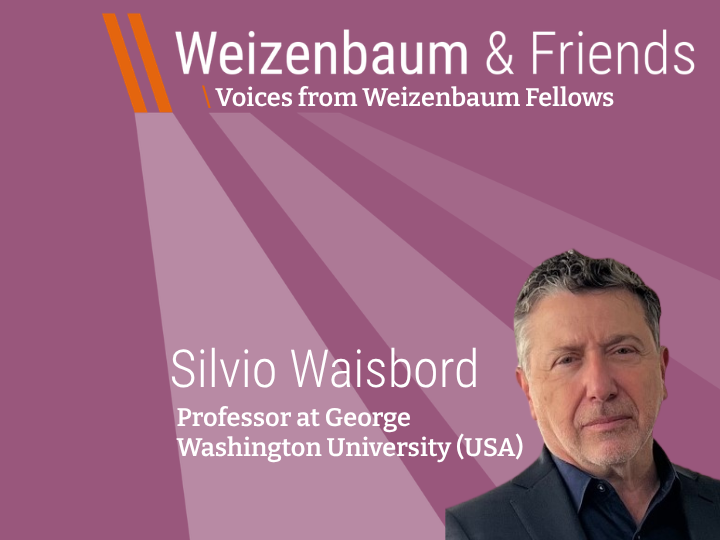
Silvio Waisbord: News, Politics, and Communication in Changing Information Ecologies
24.06.2026Silvio Waisbord is Professor at the School of Media and Public Affairs at George Washington University.
He is a leading scholar in communication studies, with research spanning journalism, politics, media policy, and communication for social change. He has authored and edited twenty books, including his most recent Introduction to Journalism: Thinking Globally (Polity), and more than sixty academic articles.
Waisbord’s academic leadership has shaped the field of communication research internationally. He currently serves as Editor of the International Journal of Communication and has previously held editorial leadership roles at the Journal of Communication and the International Journal of Press/Politics. He has also served as President of the International Communication Association and directed the School of Media and Public Affairs at George Washington University from 2020 to 2023. He holds a Licenciatura in Sociology from the Universidad de Buenos Aires and a PhD in Sociology from the University of California, San Diego.
During his fellowship at the Weizenbaum Institute, Waisbord highlights a particularly engaging intellectual environment. “Collegiality, exciting projects, welcoming environment, smart ideas,” he notes, emphasizing the combination of openness and scholarly quality that characterized his stay.
His research focuses on the relationship between news and politics in contemporary societies, particularly in the context of changing information ecologies and evolving forms of organized politics. He is interested in how transformations in media environments reshape political communication and public discourse across different societal contexts.
Reflecting on collaboration at the Institute, Waisbord emphasizes informal yet productive exchange. “People were curious about my work and willing to have conversations about mutual interests,” he explains, pointing to an atmosphere of openness and intellectual engagement across research areas.
When asked about his motivation for choosing the Weizenbaum Institute, he highlights its academic reputation, the quality of its scholarship, and its location as key factors that influenced his decision to join the fellowship.
Overall, his time at the Institute reflects a productive engagement with interdisciplinary perspectives on media, politics, and communication in an evolving global information landscape.