
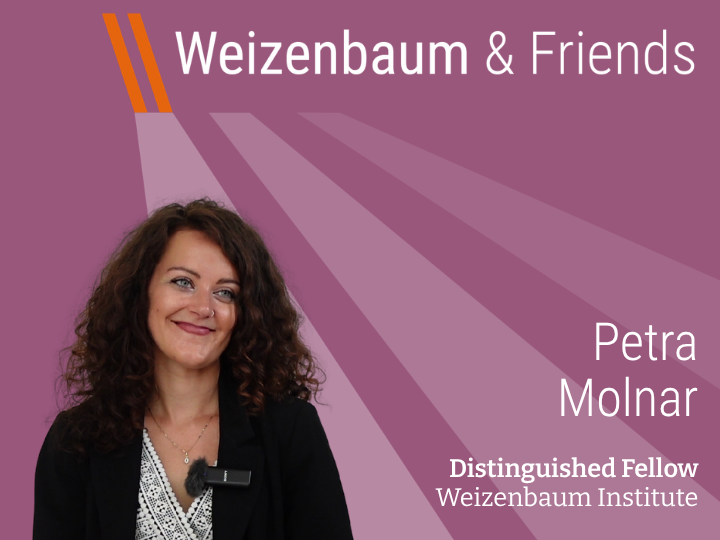
Distinguished Fellow Petra Molnar: Collaboration and Critical Perspectives on Technology, Migration, and Power
29.04.2026Petra Molnar explores how digital technologies shape migration, human rights, and global inequalities. In 2024, she was invited as a Distinguished Fellow to the Weizenbaum Institute. For our series “Weizenbaum & Friends,” she reflects on critical research, interdisciplinary collaboration, and the infrastructures behind AI-driven border systems.
Petra Molnar is a lawyer and anthropologist specializing in technology, migration, and human rights. Her work spans multiple regions, including Kenya, Palestine, Jordan, and Canada, and focuses on the social and political implications of digital technologies in border governance. She is the co-creator of the Migration and Technology Monitor, Associate Director of the Refugee Law Lab at York University, and Faculty Associate at the Berkman Klein Center at Harvard University. Her recent book, The Walls Have Eyes: Surviving Migration in the Age of Artificial Intelligence (2024), examines the human impact of AI-driven border systems. She was a distinguished fellow at Weizenbaum Institute in June 2024.
Molnar’s research interrogates the expanding use of border technologies such as biometric surveillance and AI-based risk assessment. More recently, she has shifted her focus toward the infrastructures underlying these systems. “I am increasingly looking upstream at the environmental and material infrastructures that sustain these harmful systems,” she explains, highlighting a new research project on the connections between artificial intelligence, data centers, and extractive industries. Her work asks “what ecological and social costs are hidden behind so-called ‘innovation’,” linking technological development to environmental justice and global supply chains.
Reflecting on her fellowship at the Weizenbaum Institute, Molnar emphasizes the importance of critical inquiry and intellectual openness. “What stands out most […] is the importance of intellectual openness and the willingness to ask difficult questions about power, technology, and society,” she notes. In a context where digital technologies are often framed as neutral, she underscores the need for spaces that critically examine their societal implications. At the same time, she highlights the political nature of research itself: “Research is never apolitical,” particularly in fields shaped by surveillance, migration, and geopolitical conflict.
During her time in Berlin, Molnar engaged closely with researchers across the Institute, including Dr. Betina Berendt and the “Data, Algorithmic Systems and Ethics” group led by Dr. Milagros Miceli. She particularly valued the group’s work on the human infrastructures behind digital systems, noting that it “resonates strongly with my own work on the often invisible people and communities affected by technological experimentation.”
For Molnar, institutes like the Weizenbaum Institute are crucial in fostering international collaboration. “They play a critical role in building transnational spaces for rigorous and independent research on digital society,” she argues. In an era marked by rising authoritarianism and increasing pressure on academic freedom, such spaces are essential, especially for scholars working on politically sensitive topics such as migration, surveillance, and borders.
Looking ahead, Molnar takes with her a key question: how to strengthen collaborations that connect academic research with affected communities. Through her work with the Migration and Technology Monitor, she advocates for participatory approaches that bring together researchers, journalists, technologists, and people on the move. “These kinds of collaborations that center affected communities as experts in their own right,” she explains, are essential to grounding debates on digital technologies in lived experience and global perspectives.
About the Fellowship:
The Weizenbaum Institute Fellowship enables national and international researchers at all career stages to carry out joint research projects and establish long-term collaborations. The goal is to bring new perspectives to the Institute’s research and to strengthen academic networking further. Since the Institute’s founding in 2017, over 357 fellows from 47 countries have been affiliated with the Weizenbaum Institute—an international diversity that our format „Weizenbaum & Friends“ showcases regularly.