
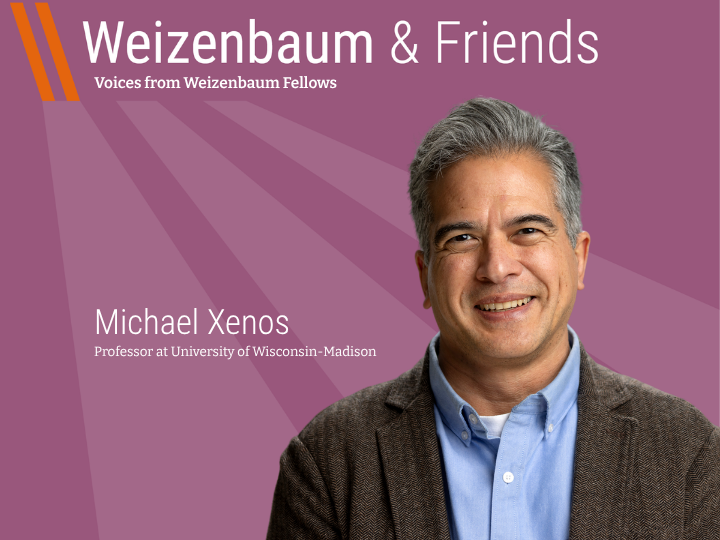
Fellow Prof. Michael Xenos: How Communication Systems Shape Public Understanding and Engagement
10/26/2026Michael Xenos is Professor in the Department of Life Sciences Communication and Associate Dean for Graduate Education in the College of Agricultural and Life Sciences at the University of Wisconsin–Madison.
His research explores how people encounter and make sense of public issues and how communication systems shape their engagement with public life. His work spans political communication, digital media, and science communication, with a particular focus on how social media and other forms of communication influence political participation, public understanding of science, and attitudes toward emerging technologies. In his recent research, Xenos examines trust and mistrust in science, investigating how individual predispositions and lived experiences interact with broader political and communication contexts to shape public engagement with scientific issues.
During his fellowship at the Weizenbaum Institute, Xenos was particularly impressed by the vibrant intellectual community surrounding the Institute. “My first thought is about how vibrant the community in and around the Institute was”, he reflects, highlighting the opportunity to engage with scholars from the Institute’s research groups, other visiting fellows, and researchers from nearby institutions.
Xenos’ research focuses on the relationship between communication systems and public engagement. “My research examines how communication systems shape the relationship between people and public issues”, he explains. Across political communication, digital media, and science communication, he investigates how people encounter information, develop understandings of emerging issues, and participate in public life. His work examines how communication environments create both opportunities and constraints for public knowledge, opinion formation, and democratic participation.
Reflecting on collaboration and exchange at the Institute, Xenos emphasizes the value of its interdisciplinary and international environment. “The diversity of types of scholars – different disciplinary backgrounds, different career stages, from all over the globe – was one of the most valuable”, he notes. During his fellowship, he collaborated closely with Martin Emmer and Pablo Porten-Chee and began a research collaboration with Sandra Gonzalez-Bailon that resulted in a joint publication after their fellowships.
When asked about his motivation for choosing the Weizenbaum Institute, Xenos highlights the opportunity to connect with researchers studying the implications of digital media for democratic citizenship across different national contexts. Beyond the academic exchange, he also recalls the unique experience of spending time in Berlin during the summer.
Overall, Xenos’ fellowship at the Weizenbaum Institute reflects a productive exchange of perspectives on digital media, communication, and democratic engagement, fostering international collaboration and interdisciplinary approaches to understanding the role of communication in contemporary societies.