Fellow Hugo Santos: Collaborative Research on Digital Labor and Inequality
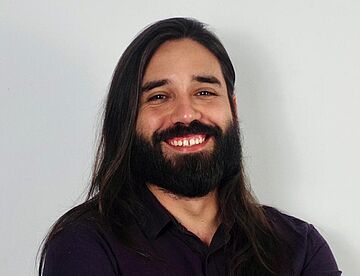
04/23/2026Fellow Hugo Santos explores how digital labor shapes workers’ health and global inequalities. At the Weizenbaum Institute, he advances a comparative study on data work in Europe and Brazil, contributing to debates on digital colonialism and sovereignty.
Hugo Santos is a psychologist and doctoral candidate in public health. In his doctoral thesis, he examines work activities, working conditions, and their impact on the health of workers in relation to data work in Brazil. As part of his research project at the Weizenbaum Institute, he is collaborating with the research group “Data, Algorithmic Systems, and Ethics” to investigate the realities of data work in Europe. The project aims to generate empirical knowledge about European data work contexts and develop a comparative study with the Brazilian scenario. He is also a member of the “Digital Work, Platforms, and Artificial Intelligence” working group of the Latin American Council of Social Sciences (CLACSO). In 2025, he received the prestigious “Aluno Nota 10” doctoral scholarship from FAPERJ and ranked first in the selection process for the scholarship, which supports his six-month research stay as a visiting scholar at the Weizenbaum Institute.
Santos’ research analyzes the relationship between work and health among data workers who train algorithmic systems via digital platforms. He situates these dynamics within broader global inequalities: “My study highlights the exploitation of labor from the Global South by technology companies in the Global North,” often conceptualized as digital colonialism. At the same time, he engages with questions of digital sovereignty, stressing “the need to regulate data work in Brazil and to use this workforce to develop locally driven technologies.”
Reflecting on his fellowship, Santos highlights both infrastructural and intellectual dimensions. “The first feeling that came to me upon my arrival was a deep sense of admiration for the Institute’s infrastructure,” he notes, emphasizing the contrast to resource constraints in Brazil. More central to his experience, however, is the collaborative environment: “Another important feeling is a sense of belonging,” he explains, pointing to the value of interdisciplinary and intercultural exchange.
During his fellowship, Santos advances a comparative research agenda: “I have been working on a project that aims to generate empirical knowledge about data work contexts in Europe and develop a comparative analysis with the Brazilian scenario.” This work is embedded in ongoing collaboration with Dr. Milagros Miceli and colleagues in the Data, Algorithmic Systems, and Ethics group. He particularly values “the opportunity to meet and interact with a wide variety of people, sharing different research perspectives.”
Santos identifies the Institute’s interdisciplinary focus as a key motivation for his application: it “brings together professionals who focus on studying the Internet as both a socio-economic and technological construct.” Looking ahead, he aims to deepen his comparative research and further consolidate academic collaborations. His objective is “to produce high-quality research outputs and gain insights that contribute both to the academic community and to ongoing discussions about digital labor and digital sovereignty“.
About the Fellowship:
The Weizenbaum Institute Fellowship enables national and international researchers at all career stages to carry out joint research projects and establish long-term collaborations. The goal is to bring new perspectives to the Institute’s research and to strengthen academic networking further. Since the Institute’s founding in 2017, over 357 fellows from 47 countries have been affiliated with the Weizenbaum Institute—an international diversity that our format „Weizenbaum & Friends“ showcases regularly.