
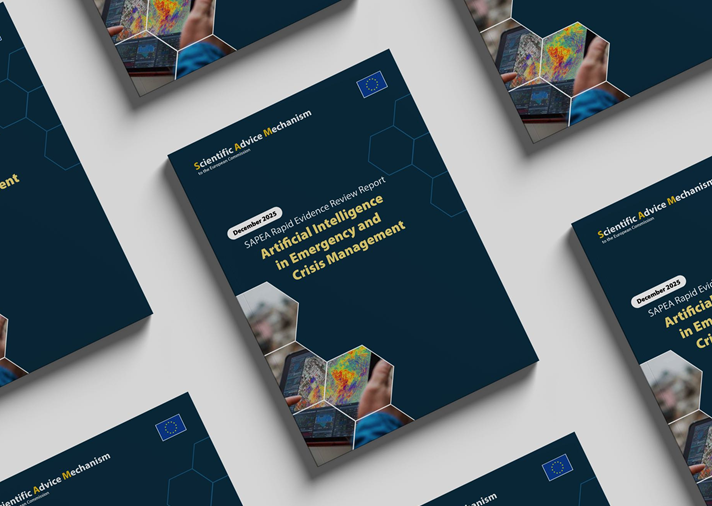
Artificial Intelligence in Emergency and Crisis Management
12/12/2025A new report by renowned scientists shows how artificial intelligence can better guide Europe through emergencies and crises in the future.
The report was presented on 11 December 2025 at the Resilience to Natural Hazards through AI Solutions Meeting in Brussels and handed over to the Directorate-General for European Civil Protection and Humanitarian Aid Operations (DG ECHO).
The expert group, which includes Weizenbaum researcher Thomas Kox, was nominated by the Network of European Academies (SAPEA) as part of the European Commission’s Scientific Advice Mechanism (SAM).
The report highlights that AI holds significant potential, particularly for standardised, data-intensive tasks. These include frequent natural hazards such as floods, wildfires and droughts. AI systems can analyse vast amounts of data, process social media content, and assess damage at a scale that exceeds human capability. They are therefore also well suited to repetitive monitoring tasks that are crucial for early warning systems.
At the same time, the scientists stress the clear limits of AI. It struggles when situations are complex, novel or highly variable and when suitable training data is lacking. Ethically sensitive decisions must also always remain the responsibility of humans.
A key barrier identified in the report is Europe’s current data fragmentation: crises cross borders, but data standards often do not. A unified European data framework could deliver crucial improvements and enable the development of reliable AI tools for crisis management across the EU.
To ensure the responsible use of AI, the report recommends developing benchmarks, guidelines, codes of conduct and supervised test environments. These measures would help ensure that AI systems are thoroughly evaluated before being deployed in real emergencies.