
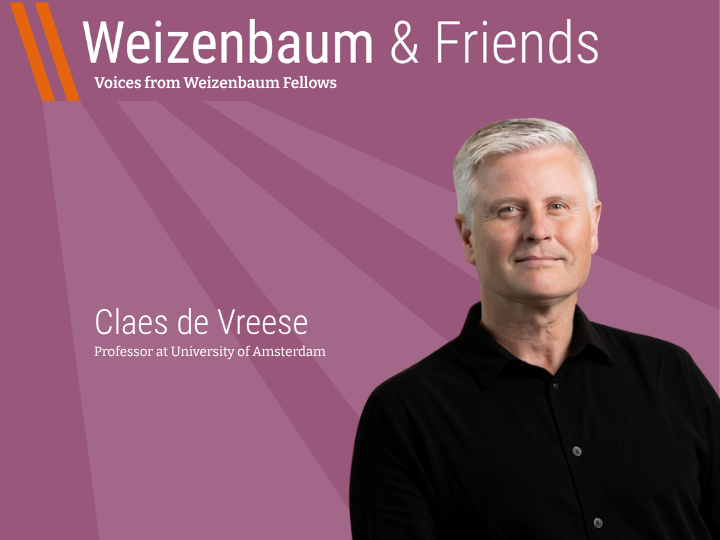
Fellow: Claes de Vreese: Comparative Perspectives on AI, Journalism, and Digital Society
02.11.2026How do artificial intelligence, journalism, and democracy shape one another? These questions are at the heart of the research conducted by Claes de Vreese, who recently visited the Weizenbaum Institute.
During his visits in March, June, October, and December 2025, he exchanged ideas with colleagues across the institute and explored opportunities for future collaboration on pressing challenges facing digital societies.
Claes de Vreese's current research focuses on the intersection of AI and journalism, examining how artificial intelligence is transforming news production and the media landscape. Another key area of interest is public opinion on AI, particularly how citizens perceive artificial intelligence and the extent to which they support its regulation. Together, these projects address some of the most pressing societal questions arising from the rapid adoption of AI technologies.
The visits provided an opportunity to engage with researchers from across the Weizenbaum Institute, particularly with Dr. Jakob Ohme's Interdisciplinary Digital News Dynamics research group. Presenting at the institute's general conference also enabled exchanges with scholars from a wide range of disciplines working on digital society research. Reflecting on the role of institutes such as the Weizenbaum Institute, de Vreese emphasized the importance of dedicated research environments for addressing the societal implications of digital technologies: “Digital technologies and AI play such a central role in today's societies that we cannot really have enough research on these challenges. The irony is that there is still so much we don't know. An institute like the Weizenbaum Institute helps shape research agendas, provide conceptual clarity, and contribute high-quality empirical evidence to both scientific and policy debates.”
A key takeaway from his stays in Berlin was the value of collaborative and interdisciplinary research. Addressing the complex challenges of digital transformation requires researchers from different disciplines to work together and combine their expertise.
“The notion that research on the digital society is most meaningful when it is done in research teams and in interdisciplinary settings was underscored by visiting the Weizenbaum Institute. The challenges are great, and we can only meaningfully address them if we work together.”
The visits further strengthened international exchange at the Weizenbaum Institute and highlighted the importance of interdisciplinary collaboration in developing a deeper understanding of digital transformation and its societal impact.