
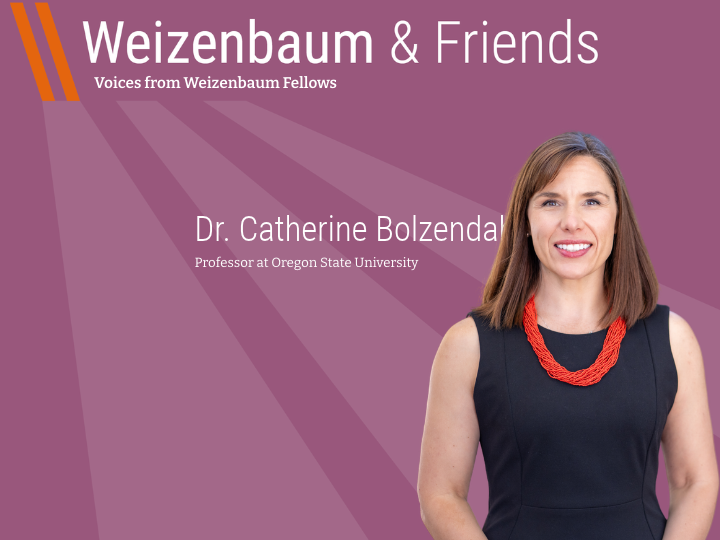
Fellow Dr. Catherine Bolzendahl: Gender Inequality in Digital Spaces
11/23/2026Her fellowship at the Weizenbaum Institute enabled her to bring the digital realm into her research on gender and politics, opening up new collaborations and insights.
Catherine Bolzendahl serves as Director of the School of Public Policy at Oregon State University, where she leads interdisciplinary programs in Economics, Political Science, Public Policy, and Sociology. An internationally recognized scholar of gender and politics, her research explores public opinion on gender inequality, family change, sexuality, and political participation across democratic societies.
Her research combines perspectives from sociology and political science to examine how social change influences political attitudes and behavior. She has published extensively in both disciplines and currently has projects on gender differences in political engagement, changing views of same-sex families, and gender inequality in legislative organizational power.
Reflecting on her experience at the Weizenbaum Institute, Bolzendahl highlights: “The ability to work with the Weizenbaum panel has been particularly formative, specifically collaborating with Katharina Heger, Christian Strippel, and Martin Emmer.” This collaboration allowed her to extend her longstanding work on gender and political participation into the digital sphere through access to unique data, interdisciplinary expertise, and a vibrant network of scholars. Through this work, she examined how online political engagement, social media participation, and online hate intersect with broader patterns of gender inequality.
Furthermore, she describes how her research stay reinforced the importance of treating digital spaces not as separate from politics and society, but as central arenas in which existing inequalities are reproduced, challenged, and transformed. Working with scholars from communication, computer science, and related fields encouraged her to think more deeply about how platform design, online interaction, and digital participation shape democratic engagement.
Bolzendahl gained new perspectives on gender inequality during her fellowship. “Across both of my collaborative Weizenbaum projects, it is clear that gender inequalities do not simply disappear online,” she says. “Digital spaces create new opportunities for participation and voice, but they can also reproduce longstanding inequalities and introduce new barriers.” The joint research suggests that online participation, social media engagement, and responses to online hostility are all shaped by gendered experiences and expectations.
Finally, her time at the Weizenbaum Institute deepened her understanding of how the mechanisms that produce gender inequality operate across both offline and online environments, and why studying them together is essential for understanding democratic participation today.